Journal — No. 002 · Summer 2025
Why cotton
gets better.
Most materials wear out. Egyptian long-staple cotton is the exception — it wears in. We went to Portugal to understand why, and came back with a ritual.

Every material you own is dying slowly. Leather dries, linen thins, synthetics pill and shed. The graph of almost everything points down. Egyptian long-staple cotton is one of the few materials whose graph points up — for years — before it levels into a long, soft plateau.
The reason is fibre length. Cotton grown in the Nile Delta produces fibres nearly twice the length of commodity cotton. Longer fibres mean fewer exposed ends, which means less friction damage per wash. Instead of fraying, the fibre relaxes. Each wash loosens the spin slightly, unlocking softness that was engineered in at the loom but arrives on a delay.
The twelfth wash
At the atelier outside Porto, the weavers talk about towels the way winemakers talk about vintages — as things that improve toward a peak. Their number is twelve. Around the twelfth wash, an 800 GSM towel reaches maximum softness and absorbency, and holds it for years.
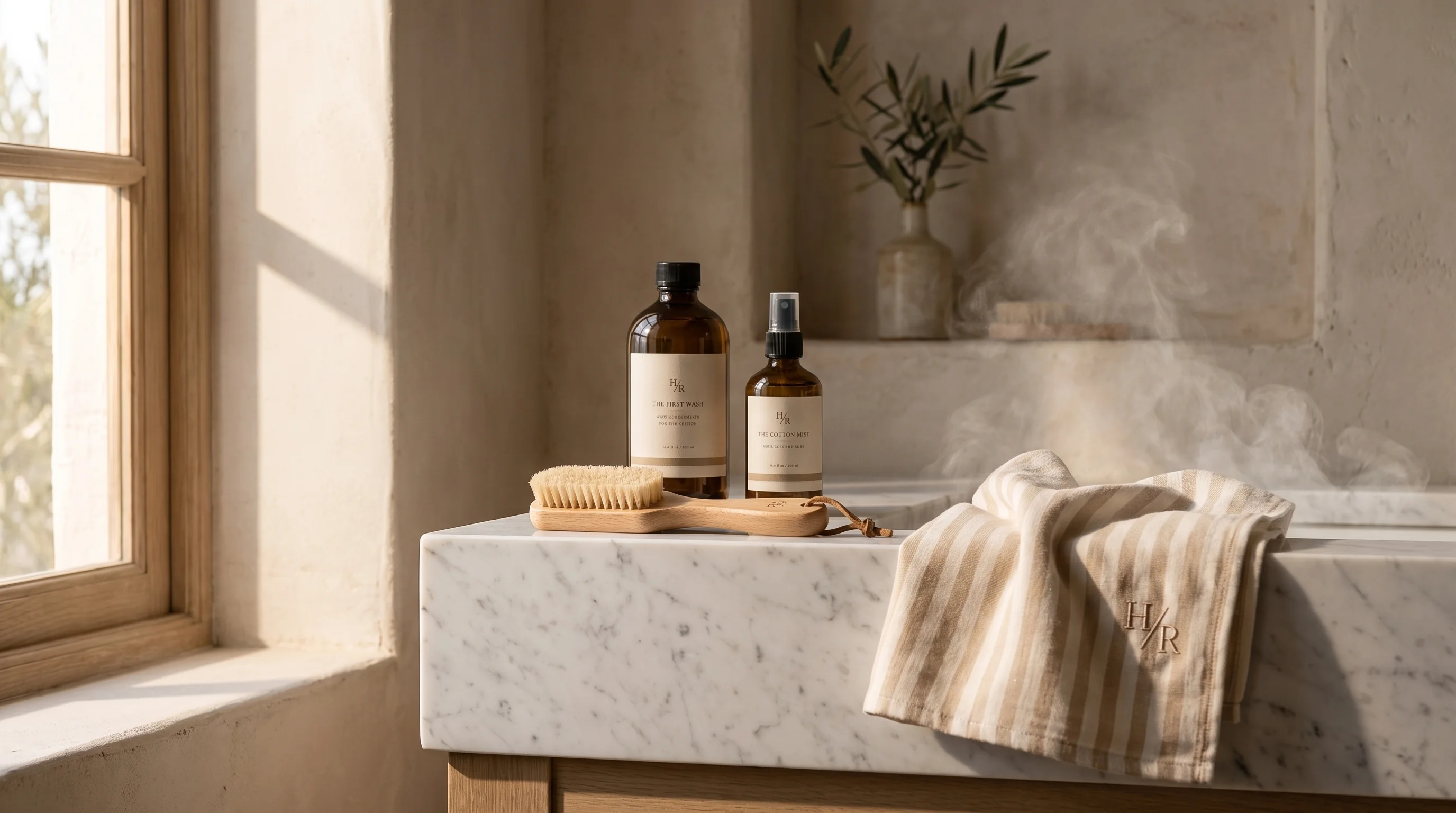
This is why the House sells a care set and calls it a ritual, not an accessory. The First Wash concentrate exists for those first twelve washes. The brush lifts the pile after each dry. None of it is complicated. It is simply the difference between owning a towel and keeping one.
We find that distinction — owning versus keeping — increasingly central to everything the House makes.
From this story
The Care Collection